This article is for educational purposes only. Always consult your healthcare provider before starting, stopping, or changing GLP-1 medication.
GLP-1 medications suppress appetite so effectively that many users struggle to eat enough — and among the nutrients most at risk from undereating, protein is at the top of the list.
This matters because rapid weight loss, particularly when protein is inadequate, causes the body to shed not just fat but muscle tissue. Muscle is metabolically active, protects your joints, supports your balance, and determines how many calories you burn at rest. Losing it during weight loss treatment accelerates what researchers call "sarcopenic obesity" — and makes weight maintenance far harder after treatment ends.
The good news: with intentional planning, you can meet protein targets on GLP-1 medications even when eating substantially less than you used to.
Why GLP-1s Create a Protein Challenge
When you're eating 1,200–1,600 kcal/day instead of your previous 2,000–2,500 kcal/day, there's simply less room for food. The typical American gets protein from meals that often include not-so-protein-dense companions — a burger in a bun, pasta with a little chicken, cereal and milk. On a suppressed appetite, those foods may feel nauseating or simply not appealing.
Meanwhile, GLP-1 users often report that protein-dense foods — particularly meat and eggs — are among the first foods they lose interest in. This anecdotal experience is consistent with the mechanism: high-protein foods are satiating partly because they trigger GLP-1 release in the gut. When that signal is already saturated by medication, the appetite-suppressing feedback from protein is amplified.
The result: people may find themselves gravitating toward small amounts of simple carbohydrates (crackers, broth, fruit) because they're easiest to tolerate — while protein intake quietly drops.
How Much Protein Do You Actually Need?
The answer is higher than most people assume. The outdated RDA of 0.8 g/kg body weight was set as a minimum to prevent deficiency — not as an optimal target for people actively losing weight.
The Evidence for Higher Protein During Weight Loss
A landmark study published in the American Journal of Clinical Nutrition found that a high-protein diet (30% of calories from protein) preserved significantly more lean mass during calorie restriction than a standard-protein diet. In the context of GLP-1 treatment, this evidence is critical.
A commonly recommended range for adults undergoing significant weight loss is 1.2–1.6 g of protein per kg of current body weight per day, with some researchers recommending up to 2.0 g/kg for active individuals or those at significant risk for muscle loss. A 2019 position paper from the International Society of Sports Nutrition supports 1.4–2.0 g/kg/day for individuals in calorie restriction.
Quick Reference Table
| Body Weight | 1.2 g/kg Target | 1.6 g/kg Target |
|---|---|---|
| 150 lbs (68 kg) | 82 g/day | 109 g/day |
| 180 lbs (82 kg) | 98 g/day | 131 g/day |
| 220 lbs (100 kg) | 120 g/day | 160 g/day |
| 250 lbs (114 kg) | 137 g/day | 182 g/day |
Use the protein needs calculator to get your personalized daily target based on your current weight, activity level, and goals.
The Muscle Loss Risk: What the Research Says
The STEP 1 trial found that participants lost an average of 15.3 kg over 68 weeks on semaglutide 2.4 mg. What the headline number doesn't capture is the composition of that loss. A subsequent body composition analysis found that approximately 38% of the weight lost in GLP-1 trials was lean mass — considerably higher than the ~25% lean mass loss seen with more modest calorie restriction.
A 2023 analysis published in Diabetes, Obesity and Metabolism examined lean body mass changes across GLP-1 trials and concluded that adequate protein intake and resistance exercise were the two most powerful levers for preserving muscle during GLP-1-assisted weight loss.
This isn't a reason to avoid GLP-1 medications — the benefits are substantial. It's a reason to treat protein intake as a medical priority, not an afterthought.
Protein Sources That Work Well on GLP-1s
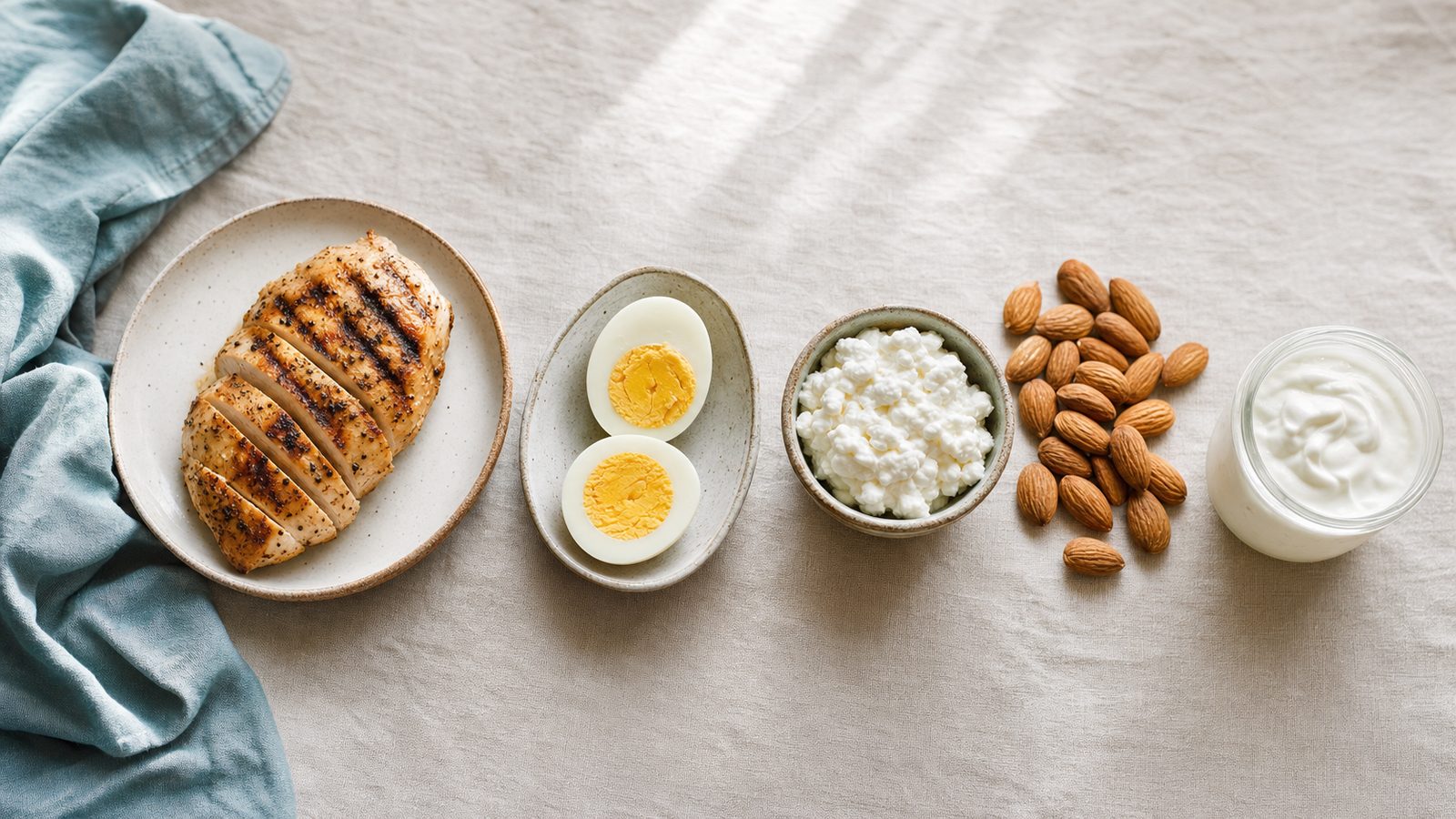
When appetite is suppressed and larger meals feel uncomfortable, the key is protein density — getting the most protein per bite.
Tier 1: High Protein-Per-Calorie Density
These are your daily anchors:
- Non-fat Greek yogurt (plain): ~17–20 g protein per 6 oz serving; easy to tolerate, cool and smooth
- Cottage cheese (low-fat): ~14 g per ½ cup; can be blended smooth if the texture is a barrier
- Egg whites: ~4 g per white; versatile, lean, and easy to cook in small portions
- Canned tuna or salmon: ~22–25 g per 3 oz; shelf-stable, easy to portion
- Shrimp: ~20 g per 3 oz cooked; light texture, often tolerated well on GLP-1s
- White fish (cod, tilapia, halibut): ~20–22 g per 3 oz; mild flavor, lean, easy to digest
Tier 2: Moderate Protein Density
Useful at meals, but don't rely on them alone:
- Chicken breast (grilled or baked): ~26 g per 3 oz, but many GLP-1 users find poultry less appealing post-medication; marinating and moist cooking methods help
- Tofu (firm or extra-firm): ~10 g per ½ cup; good plant-based option
- Tempeh: ~15 g per ½ cup; higher protein than tofu, denser texture
- Edamame: ~8 g per ½ cup; works as snacks
- Low-fat cheese: ~7–9 g per oz
Protein Supplements: When Food Isn't Enough
If you're consistently unable to reach your protein target through whole foods, a protein supplement fills the gap efficiently.
- Whey protein isolate: Fastest absorbing, high leucine content (which directly triggers muscle protein synthesis), mixes easily. 25–30 g per scoop.
- Casein protein: Slower digesting; better suited to before-bed use or in Greek yogurt mixtures.
- Plant-based blends (pea + rice): Provides complete amino acid profile; a good alternative for those who avoid dairy.
A simple protein shake — 1 scoop isolate in water or unsweetened almond milk — delivers 25–30 g of protein with 100–150 kcal. When solid food is unappealing, this can be a lifeline.
Sample Meal Patterns: High-Protein Eating on Suppressed Appetite
The common thread: prioritize protein first at every meal, before vegetables or carbs. Eat protein when you're hungriest (usually at the first meal of the day or whenever the medication's appetite suppression is lightest).
Pattern A: Traditional 3 Meals (~1,400 kcal, ~120 g protein)
Breakfast: - ¾ cup plain non-fat Greek yogurt with berries (17 g protein) - 2 whole eggs scrambled (12 g protein) - Total: ~29 g protein, ~280 kcal
Lunch: - 4 oz canned tuna over mixed greens with olive oil/lemon (26 g protein) - ½ cup cottage cheese (14 g protein) - Total: ~40 g protein, ~320 kcal
Dinner: - 4 oz baked cod or shrimp (25 g protein) - ½ cup steamed broccoli - ½ cup brown rice - Total: ~30 g protein, ~380 kcal
Protein shake (if needed to reach target): - 1 scoop whey isolate in water (~25 g protein, ~120 kcal)
Daily total: ~124 g protein, ~1,100–1,400 kcal
Pattern B: Smaller, More Frequent Meals (~1,350 kcal, ~115 g protein)
Many GLP-1 users do better with 4–5 smaller eating occasions. This also helps with nausea management.
Meal 1 (8 AM): - Protein shake with ½ banana (~25 g protein, ~200 kcal)
Meal 2 (11 AM): - 2 hard-boiled eggs + 2 oz low-fat cheese (~22 g protein, ~230 kcal)
Meal 3 (1 PM): - 3 oz shrimp + ½ cup edamame (~27 g protein, ~220 kcal)
Meal 4 (4 PM): - ¾ cup Greek yogurt with 1 tbsp almond butter (~20 g protein, ~250 kcal)
Meal 5 (7 PM): - 3 oz salmon + roasted vegetables (~22 g protein, ~300 kcal)
Daily total: ~116 g protein, ~1,200–1,400 kcal
Practical Tips for GLP-1 Users
1. Eat protein first. When your appetite is limited, you may get full before finishing a meal. If you eat protein first, you ensure that the most critical nutrient gets absorbed even if you stop early.
2. Keep ready-to-eat protein on hand. Pre-boiled eggs, Greek yogurt, string cheese, and canned fish require zero prep. When appetite windows are short, convenience is critical.
3. Don't skip your morning protein. Many GLP-1 users find they have relatively more appetite in the morning. This is the best window to front-load protein.
4. Pair protein with resistance training. Protein alone preserves muscle, but protein + resistance exercise is substantially more effective. Even 2–3 sessions of light weight training per week, combined with adequate protein, significantly reduces lean mass loss. A meta-analysis in the British Journal of Sports Medicine found that resistance exercise preserved lean mass even during substantial calorie restriction.
5. Track for accountability. Apps like Cronometer, Lose It!, or MyFitnessPal allow you to log protein specifically. Even two weeks of tracking can reveal gaps you wouldn't have noticed. Use the protein needs calculator to set your target.
Independent Analysis: The Protein-Lean-Mass-GLP-1 Triangle Is More Quantifiable Than Most Guides Admit
Three observations from the STEP body composition substudies and muscle protein synthesis literature that make the protein strategy on semaglutide more precise than generic "eat more protein" advice:
1. The lean mass loss fraction on semaglutide is quantified — and it is large
The STEP 1 body composition substudy used dual-energy X-ray absorptiometry (DEXA) in a subset of participants and found that approximately 40% of total mass lost consisted of lean (non-fat) mass. In a patient losing 30 lbs on semaglutide, that translates to roughly 12 lbs of lean mass — approximately 5.5 kg. For context, 5.5 kg of muscle loss in an older adult represents meaningful functional decline: grip strength, gait speed, and stair-climbing ability are all correlated with lean mass at this magnitude. This is not a trivial cosmetic concern — it has functional health consequences. The SURMOUNT-1 body composition data for tirzepatide showed a similar lean mass fraction (approximately 41% at 15 mg without exercise guidance). The implication is that lean mass loss at this scale is the expected default outcome on GLP-1 therapy without intervention, not an outlier or worst-case scenario.
2. The 0.7–1.0 g/lb goal-weight target is derived from a specific evidence base — and it is conservative
The 0.7–1.0 g/lb goal-weight target widely cited in obesity medicine comes from two lines of evidence: (1) nitrogen balance studies showing that adults in caloric restriction require higher protein relative to body weight to maintain lean mass, with the 2019 ISSN position stand on protein recommending 1.6–2.2 g/kg/day during caloric restriction for lean mass retention; (2) practical application to weight loss contexts where "goal weight" is used instead of current weight to avoid escalating protein targets as patients remain larger. Using current body weight at 1.6–2.2 g/kg produces protein targets that may be difficult to hit at GLP-1-restricted caloric intakes for heavier patients — goal-weight scaling is a pragmatic adjustment. This means the 0.7 g/lb goal-weight target is already a downward compromise from what pure lean-mass-preservation data would recommend. The "conservative" target is actually the floor, not the ceiling.
3. Leucine threshold per meal is the mechanism — and it changes meal planning strategy
Muscle protein synthesis is not stimulated proportionally by protein intake — it requires a minimum leucine threshold per meal to maximally trigger the mTOR pathway. Research from Norton and Layman's leucine threshold work identifies approximately 2–3 g of leucine per meal as the minimum to maximally stimulate muscle protein synthesis, corresponding to roughly 25–40 g of complete protein per meal depending on the source. The practical implication for GLP-1 users: spreading 100 g of protein across five 20-gram servings is less effective for lean mass preservation than hitting 25–40 g at three meals. Eating 15 g of protein three times per day and supplementing with a 40-gram protein shake hits leucine threshold and is more effective than eating 25 g of protein six times per day. Frequency of eating is less important than hitting the per-meal leucine threshold at least three times daily.
What this means for building a protein strategy on semaglutide
The practical protocol that emerges from this evidence base: set a daily target using the 0.7–1.0 g/lb goal-weight formula; plan meals to hit 25–40 g of complete protein per sitting, not less; eat protein before carbohydrates at every meal; and add resistance training at least twice per week, because protein and exercise are synergistic on lean mass retention — not interchangeable. If you cannot reach protein targets through food alone due to GLP-1-related reduced appetite for meat and legumes, a whey or casein protein supplement is a reasonable bridge — evidence supports supplemental protein's equivalence to food protein for muscle synthesis purposes. See our nutrition and macros guide for the broader dietary framework and our protein target calculator for personalized targets.
Frequently Asked Questions
How much protein do I need per day on Ozempic or Wegovy?
The widely used target in obesity medicine is 0.7–1.0 g per pound of goal body weight per day. For a person with a 150-pound goal weight, that is 105–150 g of protein per day. This target is higher than standard dietary recommendations because caloric restriction during GLP-1 therapy increases the proportion of weight lost from lean mass, requiring extra protein to counteract that effect.
Why is protein so important specifically on semaglutide?
GLP-1 medications produce rapid, significant weight loss — but without adequate protein and resistance training, approximately 40% of that weight loss comes from lean mass rather than fat, based on STEP 1 body composition substudies. This is a larger lean mass loss fraction than typical in slower dietary-only weight loss. The speed of loss on semaglutide, combined with reduced appetite (especially for protein-dense foods), makes deliberate protein targeting essential.
Can I use protein shakes to meet my protein target on Wegovy?
Yes. Whey, casein, and soy protein isolates all support muscle protein synthesis effectively when used as a supplement to food. Whey is rapidly absorbed and well-suited to post-exercise periods; casein is slow-digesting and useful before sleep. Aim for products providing 20–30 g of protein per serving with minimal added sugar. For GLP-1 users who experience nausea with large meals, protein shakes offer a lower-volume way to hit daily targets.
What are the best high-protein foods for GLP-1 users who experience nausea with meat?
Soft, high-protein foods tend to be better tolerated during GLP-1 nausea: Greek yogurt (15–20 g per cup), cottage cheese (12–14 g per half cup), eggs (6 g per egg), soft fish like tilapia or salmon, tofu, and protein shakes. These are lower in fat than red meat — reducing the fat-triggered gastric slowing that worsens GLP-1 nausea — while still providing complete protein and meaningful leucine per serving.
What is the leucine threshold and does it matter for my meal planning?
Leucine is the branched-chain amino acid most responsible for triggering muscle protein synthesis via the mTOR pathway. Research suggests a minimum of approximately 2–3 g of leucine per meal is needed to maximally stimulate this response, corresponding to 25–40 g of complete protein per meal depending on the food source. Eating smaller amounts of protein more frequently does not replicate the muscle synthesis signal of fewer, larger protein servings at or above this threshold.
Does resistance training matter on Ozempic if I am eating enough protein?
Yes, and the two are synergistic rather than interchangeable. STEP 1 body composition data showed that patients who combined semaglutide with resistance exercise retained substantially more lean mass than those on semaglutide alone with adequate protein. Resistance training creates a stimulus for muscle protein synthesis that dietary protein alone cannot replicate. Even 2 sessions per week of progressive resistance training produces a meaningful lean mass preservation effect.
What happens to my muscle mass after I stop Ozempic or Wegovy?
Weight regain after stopping GLP-1 therapy (documented at approximately two-thirds of lost weight within a year in STEP 4) includes fat regain. Whether lean mass is also recovered depends on diet and exercise after discontinuation. Patients who regain weight rapidly and passively tend to regain primarily fat, worsening body composition compared to pre-treatment. Those who continue resistance training and adequate protein during regain tend to recover more lean mass. This is another argument for establishing a strength training habit during GLP-1 therapy, before stopping the medication.
Sources
- Wilding JPH, et al. "Once-Weekly Semaglutide in Adults with Overweight or Obesity." NEJM, 2021. https://www.nejm.org/doi/full/10.1056/NEJMoa2032183
- Paddon-Jones D, et al. "Protein and healthy aging." American Journal of Clinical Nutrition, 2015. https://academic.oup.com/ajcn/article/101/6/1339S/4564409
- Stokes T, et al. "Recent Perspectives Regarding the Role of Dietary Protein for the Promotion of Muscle Hypertrophy." Nutrients, 2018. https://www.mdpi.com/2072-6643/10/2/180
- Jäger R, et al. "International Society of Sports Nutrition Position Stand: protein and exercise." JISSN, 2017. https://jissn.biomedcentral.com/articles/10.1186/s12970-017-0177-8
- Ida S, et al. "Lean mass changes with GLP-1 receptor agonist treatment." Diabetes, Obesity and Metabolism, 2023. https://dom-pubs.onlinelibrary.wiley.com/doi/10.1111/dom.15024
- Morton RW, et al. "A systematic review, meta-analysis and meta-regression of the effect of protein supplementation on resistance training–induced gains in muscle mass and strength." British Journal of Sports Medicine, 2018. https://bjsm.bmj.com/content/56/18/1024